|
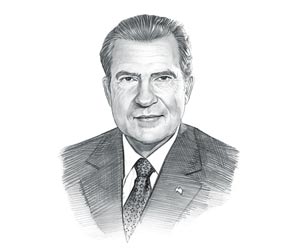
The major accomplishments and the
famous, main events that occurred during the time that
Richard Nixon was president began in 1969 when Neil
Armstrong became the first man to walk on the moon.
18-year-olds got the right to vote, the SALT Treaty was
signed, Detente was established and
the Vietnam War ended. The Pentagon Papers were leaked
bringing concerns about the integrity of the government
but they did not implicate the Nixon administration.
Then the Watergate Scandal broke. The conspiracy and
cover-up of the Watergate Break-in brought down Richard
Nixon, who resigned before he could be impeached. Richard Nixon
resigned from office and died due to a stroke on April
22, 1994, aged 81. The next
president was Gerald Ford.
Birthday:
January 9, 1913
Place of Birth:
California
Political Party:
Republican
Nickname:
Tricky Dicky
Number: 37th
President
Vice Presidents:
Spiro T. Agnew and Gerald Ford
Age at Inauguration:
56
Height: 6 feet
Weight: 175
pounds
First Lady:
Pat Nixon
Religion:
Quaker
Date of Death:
April 22, 1994
Date of Richard
Nixon
Presidency:
January 20, 1969 to August 9, 1974
The Nickname of Richard Nixon: Tricky Dicky
The nickname of President Richard Nixon provides an insight into how
the man was viewed by the American public during his presidency. The
meaning of the nickname "Tricky Dicky" originally referred to
allegations of dirty tricks during the 1950 US Senate race in
California. The "Tricky Dicky" nickname resurfaced following the
conspiracy and cover-up of the Watergate Scandal.
Character and Personality Type of Richard Nixon
The character traits of President Richard Nixon can be
described as serious, forceful, introverted intellectual,
diligent, devious and evasive. Richard Nixon also suffered from
low self-esteem with feelings of inadequacy. It has been
speculated that the Myers-Briggs personality type for Richard
Nixon is an INTJ (introversion, intuition, thinking, judgment).
A strong, reserved, independent and character. Richard Nixon
Personality type: an individualist, efficient with a high level
of confidence in their ability and talents, making them natural
leader
Accomplishments of Richard Nixon and the Famous Events during
his Presidency
The accomplishments of Richard Nixon and the most famous events
during his presidency are provided in an interesting, short
summary format detailed below.
The Cold War (1945 - 1991)
Summary of the Cold War:
The Cold War
(1945
- 1991) was a 'war of words' involving the Cold War
Space Race and the Cold War Arms Race involving the nuclear build-up
between the USA and the West and the Communist countries dominated
by the USSR and China in the East.
Richard Nixon was one of the nine US Presidents who were in office
during the dangerous period in history known as the Cold War in
which the US adopted the policy of
Containment
to restrict the spread of communism abroad.
Stagflation (1970's)
Summary of Stagflation:
Stagflation
was the term used to describe the state of the nation's economy
during the 1970's and the Richard Nixon administration. Stagflation
was a combination of economic stagnation, rising prices and
inflation. President Richard Nixon failed to curb stagflation and
the worst recession since the Great Depression continued into the
presidencies of Gerald Ford and Jimmy Carter until the economy
finally began to recover during the administration of Ronald Reagan.
The Vietnam War (1955 - 1975)
Summary of the Vietnam War: The
Vietnam War
(November 1, 1955 – April 30,
1975) between communist North Vietnam and the Viet Cong communist
guerrillas (backed by China and the USSR) against the non-communist
South Vietnam (supported by US military aid and involvement). There
were four US presidents during the Vietnam War: Dwight D.
Eisenhower, John F. Kennedy, Lyndon B. Johnson and Richard Nixon
The first US combat troops were sent to Vietnam in March 1965 and
left in August 1973.
Richard Nixon and the Vietnam War
Summary: President Nixon authorized 'Operation
Breakfast' (18 March 1969 until 26 May 1970), the secret bombing of
Cambodia in an attempt to destroy supply routes. On April 30, 1970
President Nixon announced that he had extended the Vietnam War into
Cambodia, requiring the need to draft 150,000 more U.S. soldiers
into the war effort, that sparked protests across the nation that
led to the
Kent State Shooting.
The Kent State Shooting (1970)
Summary of the Kent State Shooting: The
Kent
State Shooting
occurred on May 4, 1970 when 4 students were shot dead
at Kent State University by Ohio National Guardsmen during a protest
against the escalation of the Vietnam War into Cambodia and the need
to draft 150,000 more U.S. troops.
Vietnamization (1969)
Summary of Vietnamization:
Vietnamization
was the term used by Richard Nixon in a broadcast
speech on November 3, 1969
to describe his aim at achieving “peace with honor” in the
Vietnam War.
The Pentagon Papers (1971)
Summary of the Pentagon Papers: The
Pentagon
Papers
was the name given to a secret Department of Defense
study of U.S. political and military involvement in Vietnam from
1945 to 1967.
The Pentagon Papers
leaked March 1971 revealing that the US government, in
administrations prior to that of Richard Nixon, had been
dishonest with the American public.
SALT Treaty (1972)
Summary of the SALT Treaty: The Strategic Arms Limitation Talks
(SALT) that began in November 1969 and ended in
January 1972,
resulted in the
SALT Treaty
between the United States and the Soviet Union.
The End of the Vietnam War
Summary of the End of the Vietnam War: The
End of the Vietnam War
(November 1, 1955 – April 30, 1975)
officially ended on April 30, 1975 although
direct U.S. military involvement ended on 15 August 1973.
The First Earth Day (1970)
Summary of Earth Day: The first
Earth Day
was established following the disastrous 1969 Santa Barbara oil spill. It was organized by
Gaylord Nelson and held on Wednesday, April 22, 1970 as a
large-scale demonstration on behalf of the environment which came to
be known as "Earth Day".
1970 Clean Air Act
Summary of the Clean Air Act: Richard Nixon signed the extension to the
Clean Air Act
in 1970 aimed at phasing out leaded gas by the
mid-1980s, and the establishment of the
Environmental
Protection Agency (EPA) on July 9, 1970.
Roe v Wade (1973)
Summary of Roe v Wade: The Supreme Court decision in
Roe v Wade
declared that all the individual state bans on
abortion, during the first trimester, to be unconstitutional. The
law allowed states to regulate, but not to ban, abortion during the
second trimester and allowed states to ban abortion in all
trimesters, unless abortion was in the best interest of the woman's
physical or mental health.
Arab-Israeli Conflict (1973)
Summary of the of the Arab-Israeli Conflict: The 1973
Arab-Israeli
Conflict, aka the Yom Kippur War, was fought from October 6 to October 25, 1973 by
the coalition of Arab states led by Egypt and Syria (supported by
USSR) against Israel (supported by USA).
The Watergate Scandal (1974)
Summary of the Watergate Scandal: The conspiracy and cover-up of the
Watergate Break-in led to the
Watergate
Scandal. President
Richard Nixon and many
of his aides were implicated in the web of lies and conspiracies and
the Watergate Scandal culminated in the president's resignation on
August 9, 1974. Richard Nixon resigned before he could be impeached.
|